
Designing a safe and efficient foundation is crucial for any structural project. In this article, we explore how to determine the foundation dimension using Terzaghi’s bearing capacity formula with a factor of safety of 3. We evaluate two scenarios: when the water table is one meter below the foundation base, and when it rises to the ground surface.
Understanding the Problem
A square footing must be designed to carry a load of 2400 kN. Soil parameters are:
We use Terzaghi’s general shear failure formula:
qu = 1.3 * c * Nc + q * Nq + 0.4 * B * γ * Nγ
Where:
Applied load (Qall) = 2400 kN
Factor of Safety (FS) = 3
Thus, required ultimate load capacity:
qu = (Qall / Area) * FS = (2400 / B²) * 3 = 7200 / B²
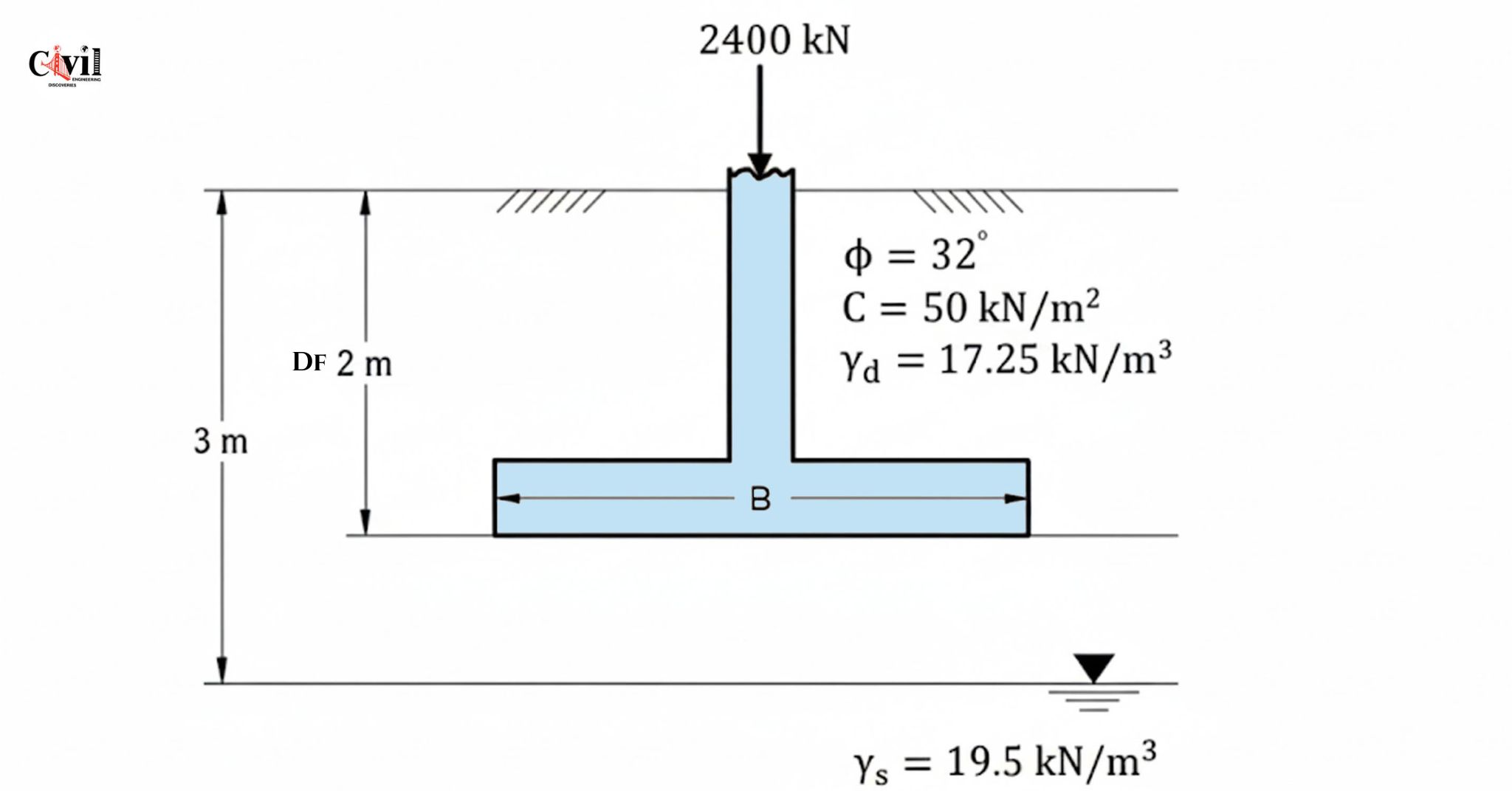
Case A: Water Table at 1 m Below Foundation Base
Effective unit weight γ’ is reduced due to partial submergence:
γ’ = γsat – γw = 19.5 – 10 = 9.5 kN/m³ , d = 3 -2 = 1m
Equivalent unit weight for calculations:
γ = γˉ = γ’ + d (γd – γ’)/B
γ = 9.5 + 1(17.25 – 9.25)/B
γ = 9.5 + (7.75 / B)
Overburden pressure:
q (effective stress) = γd * Df = 17.25 * 2 = 34.5 kN/m²
Bearing capacity factors for φ = 32° are:
Substitute values:
qu = 1.3 * c * Nc + q * Nq + 0.4 * B * γ * Nγ
7200 / B² = 1.3 * 50 * 44.04 + 34.5 * 28.52 + 0.4 * B * (9.5 + 7.75/B) * 26.87
After simplification:
7200 / B² = 3923.837 + 102.106B
Solving the cubic equation gives:
B ≈ 1.33 m
Case B: Water Table at Ground Surface
Here, the effective stress reduces further:
q = (γsat – γw) * Df = (19.5 – 10) * 2 = 19 kN/m²
γ = γ’ = γsat – γw
= 19.5 – 10 = 9.5 kN/m³
Using Terzaghi’s formula:
qu = 1.3 * c * Nc + q * Nq + 0.4 * B * γ * Nγ
7200 / B² = 1.3 * 50 * 44.04 + 19 * 28.52 + 0.4 * B * 9.5 * 26.87
Simplify:
7200 / B² = 3404.48 + 102.106B
Final solution:
B ≈ 1.42 m
Key Insights
Click Here To See What Is The Void Ratio Of Soil? Significance And Formula Explained
Loading related articles...
Loading recent articles...
Loading featured articles...
