
Understanding lateral earth pressure is essential for designing safe and stable retaining walls. This calculation is particularly important when the wall movement is negligible, and the soil remains in its natural state, also known as the “at rest” condition.
Given Soil Profile and Properties
Soil Layers and Their Characteristics
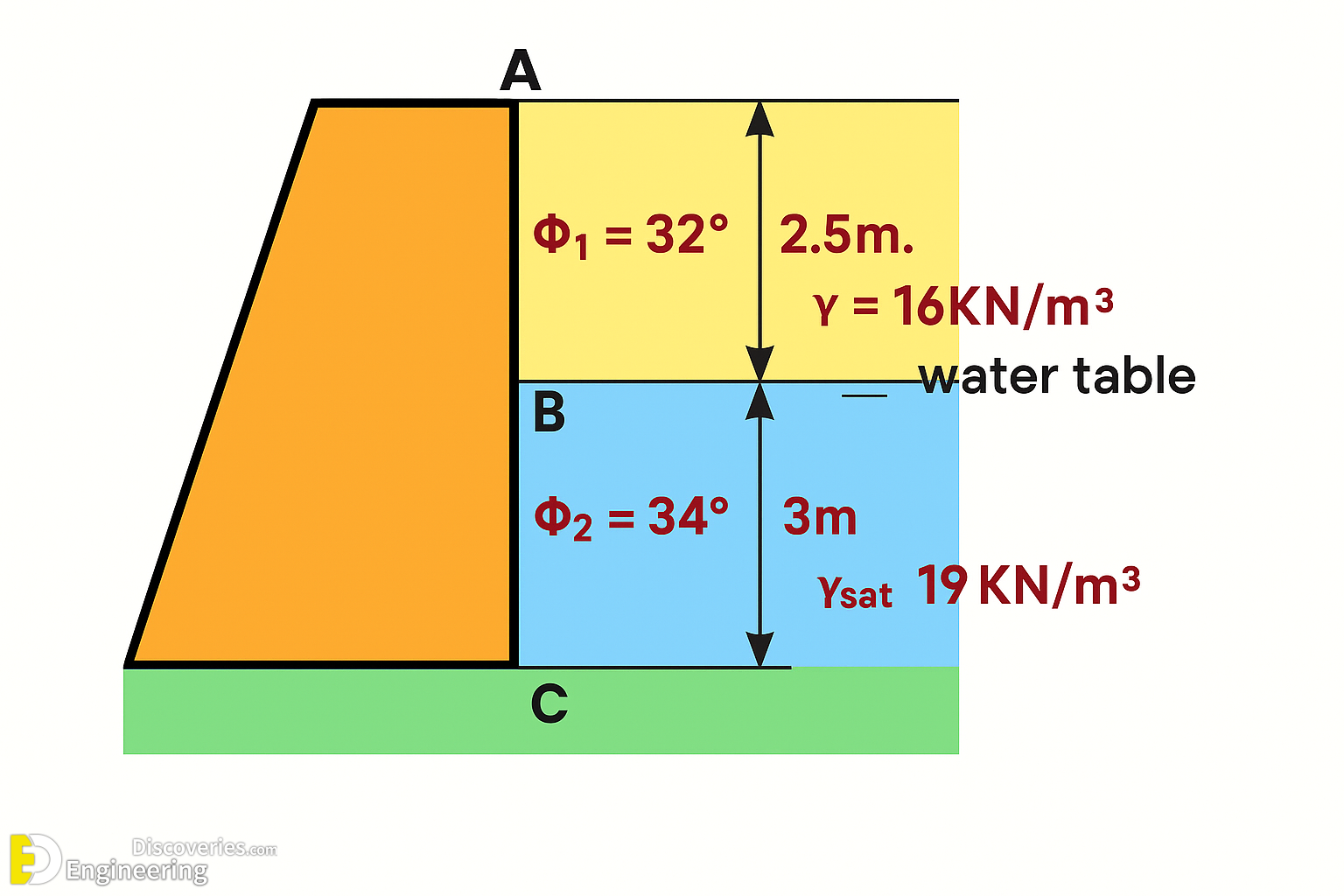
Angle of internal friction (𝜙₁) = 32°
Angle of internal friction (𝜙₂) = 34°
Submerged Unit Weight Calculation
The submerged unit weight (γ’) of the second layer:
γ’ = γ_sat – γ_w = 19 – 10 = 9 kN/m³
Earth Pressure Coefficients (At Rest Condition)
For First Layer (Ka₁):
Ka₁ = 1 – sin(𝜙₁)
Ka₁ = 1 – sin(32°)
Ka₁ ≈ 1 – 0.5299 = 0.47
For Second Layer (Ka₂):
Ka₂ = 1 – sin(𝜙₂)
Ka₂ = 1 – sin(34°)
Ka₂ ≈ 1 – 0.5591 = 0.4408
Earth Pressure Intensities
At Base of First Layer (Point B):
p₀₁ = Ka₁ × γ × H₁
p₀₁ = 0.47 × 16 × 2.5 = 18.80 kN/m²
Due to the First Layer at the Bottom of the Second Layer (Point C):
p₀₂ = Ka₂ × γ × H₁
p₀₂ = 0.4408 × 16 × 2.5 = 17.632 kN/m²
Due to Second Layer (Submerged Weight):
p₀₃ = Ka₂ × γ’ × H₂
p₀₃ = 0.4408 × 9 × 3 = 11.016 kN/m²
Water Pressure in Second Layer:
u = γ_w × H₂
u = 10 × 3 = 30 kN/m²
Note: Water pressure in the first layer is zero since the water table starts from the second layer.
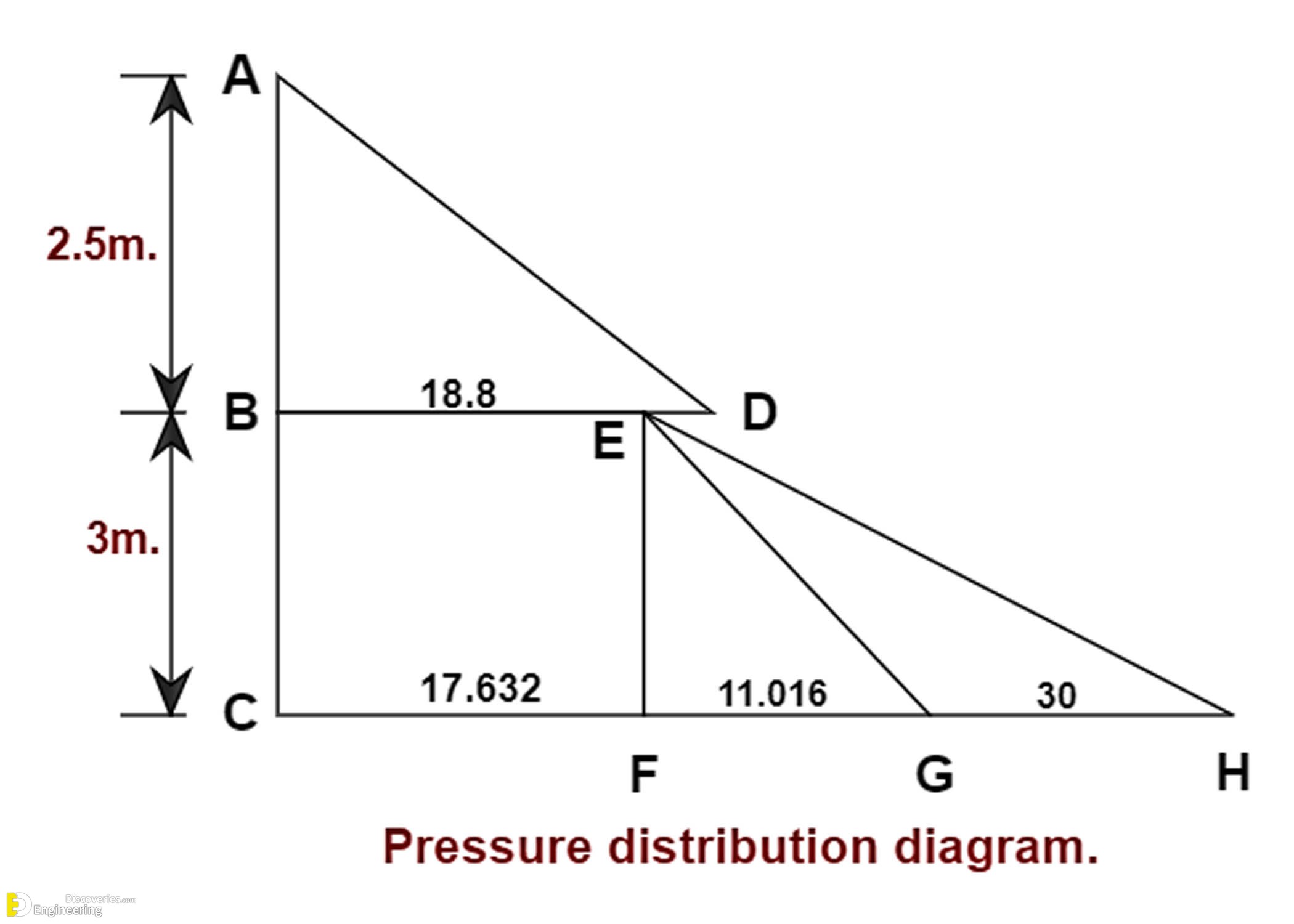
Total Pressure Distribution
Pressure Components
Summation of Total Active Earth Pressure
P_total = P₁ + P₂ + P₃ + P₄
P_total = 23.5 + 52.896 + 16.524 + 45 = 137.92 kN
Location of Resultant Earth Pressure
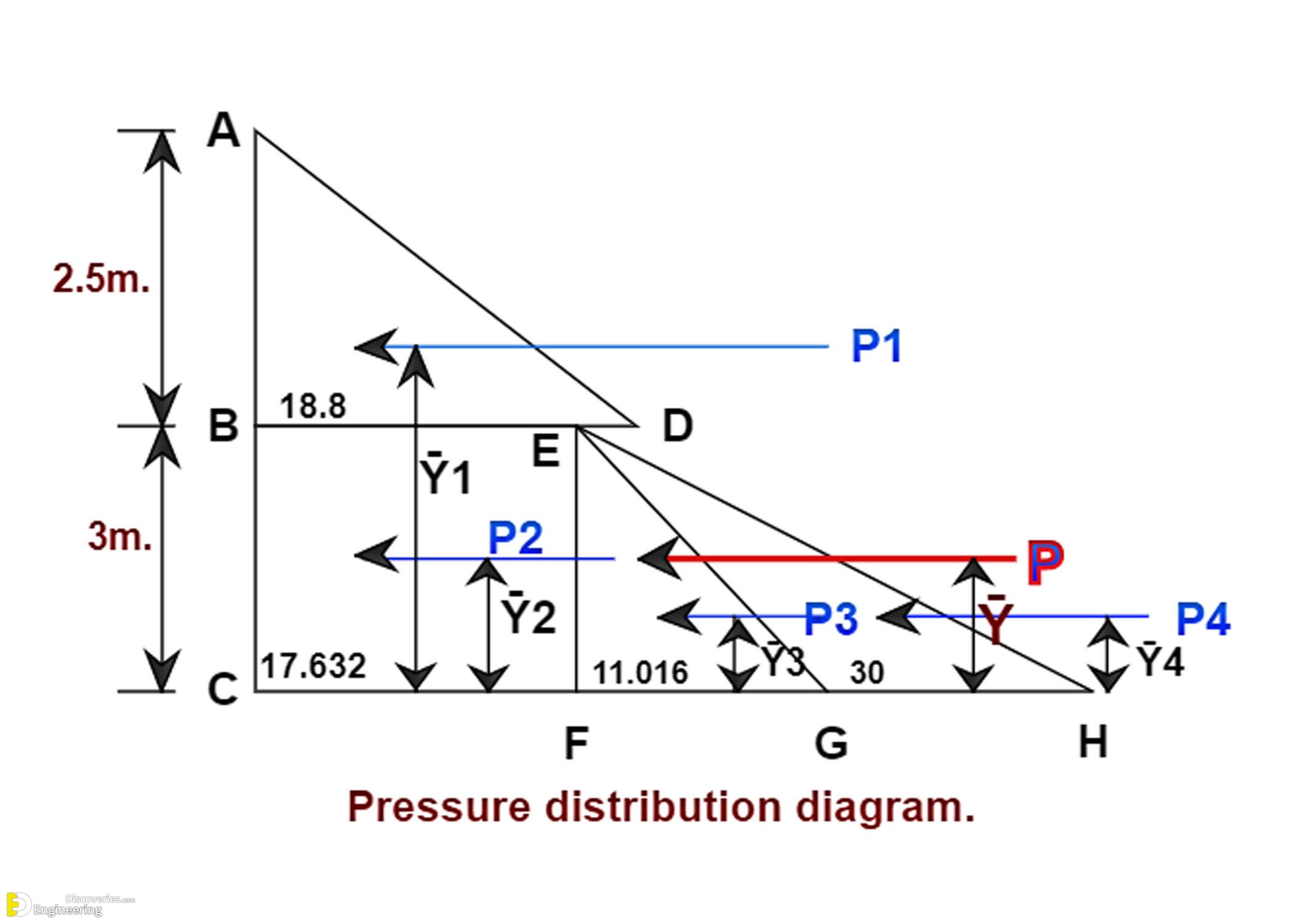
Centroid of Pressure Diagram
Moment Calculation
PȲ = (23.5 × 3.833) + (52.896 × 1.5) + (16.524 × 1) + (45 × 1)
PȲ = 90.076 + 79.344 + 16.524 + 45 = 230.944 kNm
Ȳ = PȲ / P_total = 230.944 / 137.92 = 1.675 m
Final Result
The total lateral earth pressure is 137.92 kN, and it acts at 1.675 meters from the base of the retaining wall.
Click Here To See Types Of Retaining Wall
Loading related articles...
Loading recent articles...
Loading featured articles...
