
In civil engineering, contour maps are often used to determine the volume of earthwork involved in excavations or embankments. The calculation is based on the areas enclosed by different contour lines and the vertical interval between them. Two commonly used methods are the Trapezoidal Formula and the Prismoidal Formula.
In this example, we are tasked with calculating the volume of a hill using contour data taken at 3-meter intervals.
Given Data
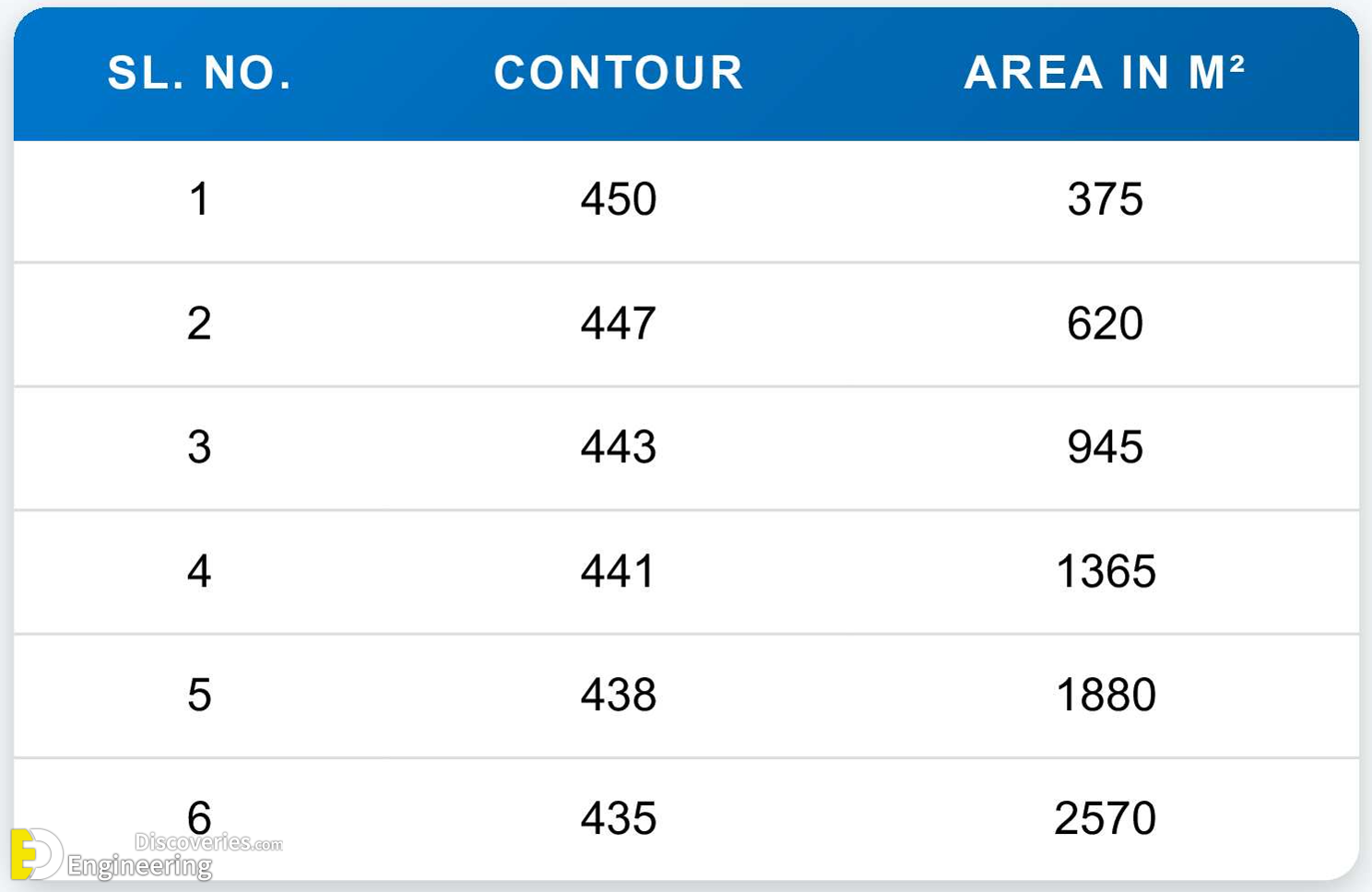
A₀ = 375 m²
1. Using the Trapezoidal Formula
Formula:
Volume = D × [ (A₀ + Aₙ) ÷ 2 + (A₁ + A₂ + … + Aₙ₋₁) ]
Calculation:
Volume = 3 × [ (375 + 2570) ÷ 2 + (620 + 945 + 1365 + 1880) ]
Volume = 3 × [ 1472.5 + 4810 ]
Volume = 3 × 6282.5
Volume = 18,847.5 m³
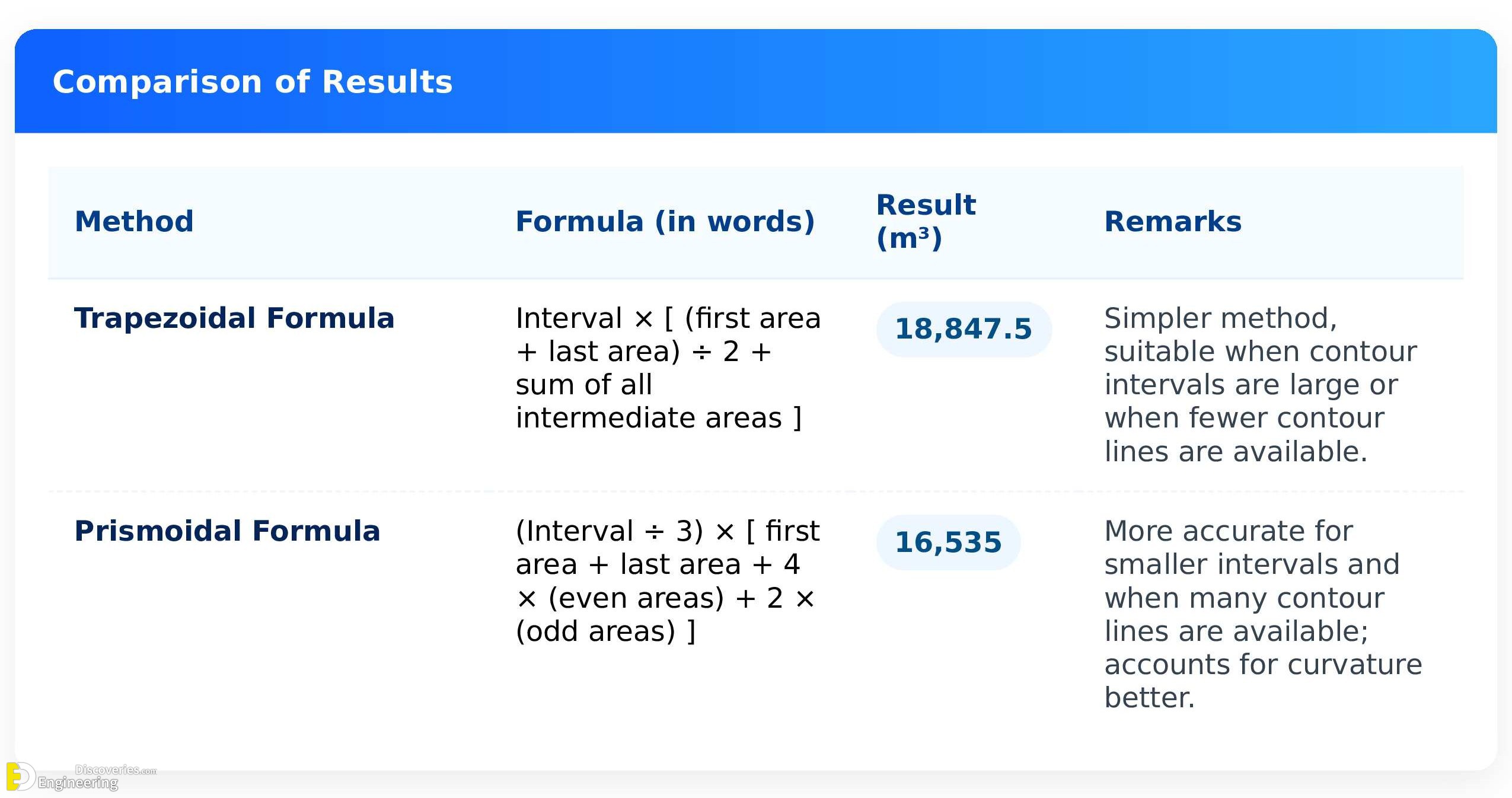
Result (Trapezoidal Formula): 18,847.5 m³
2. Using the Prismoidal Formula
Formula:
Volume = (D ÷ 3) × [ A₀ + Aₙ + 4 × (sum of even-numbered areas) + 2 × (sum of odd-numbered areas) ]
Calculation:
Volume = (3 ÷ 3) × [ (375 + 2570) + 4 × (620 + 1365) + 2 × (945 + 1880) ]
Volume = 1 × [ 2945 + 7940 + 5650 ]
Volume = 1 × 16,535
Volume = 16,535 m³
Result (Prismoidal Formula): 16,535 m³
Conclusion
The prismoidal formula generally provides more accurate results when there are many contour intervals with small spacing, as it accounts for curvature more effectively. The trapezoidal formula, on the other hand, is simpler and works better when the number of contour data points is limited and the intervals are large.
In practical applications, the choice of formula depends on the level of accuracy required and the nature of the terrain.
Click Here To See How To Transfer And Calculate RL Of Benchmark On Construction Site
Loading related articles...
Loading recent articles...
Loading featured articles...
