The load at which a member or a structure as a whole collapses in service or buckles in a load test.
The self weights of all permanent constructions and installations including the self weights of all walls, partitions, floors, and roofs.
The restraint which reduces sufficient resistance in a plane perpendicular to the plane of bending to restrain the compression flange of a loaded strut, beam or girder from buckling to either side at the point of application of the restraint.
The elastic moment which will initiate yielding or cause buckling.
The factor by which the yield stress of the material of a member is divided to arrive at the permissible stress in the material.
The transverse spacing between parallel adjacent lines of fasteners.
The load assumed to be produced by the intended use of occupancy including distributed, concentrated, impact and vibration and snow loads but excluding, wind and earthquake loads.
The numerical factor by which the working load is to be multiplied to obtain an appropriate design ultimate load.
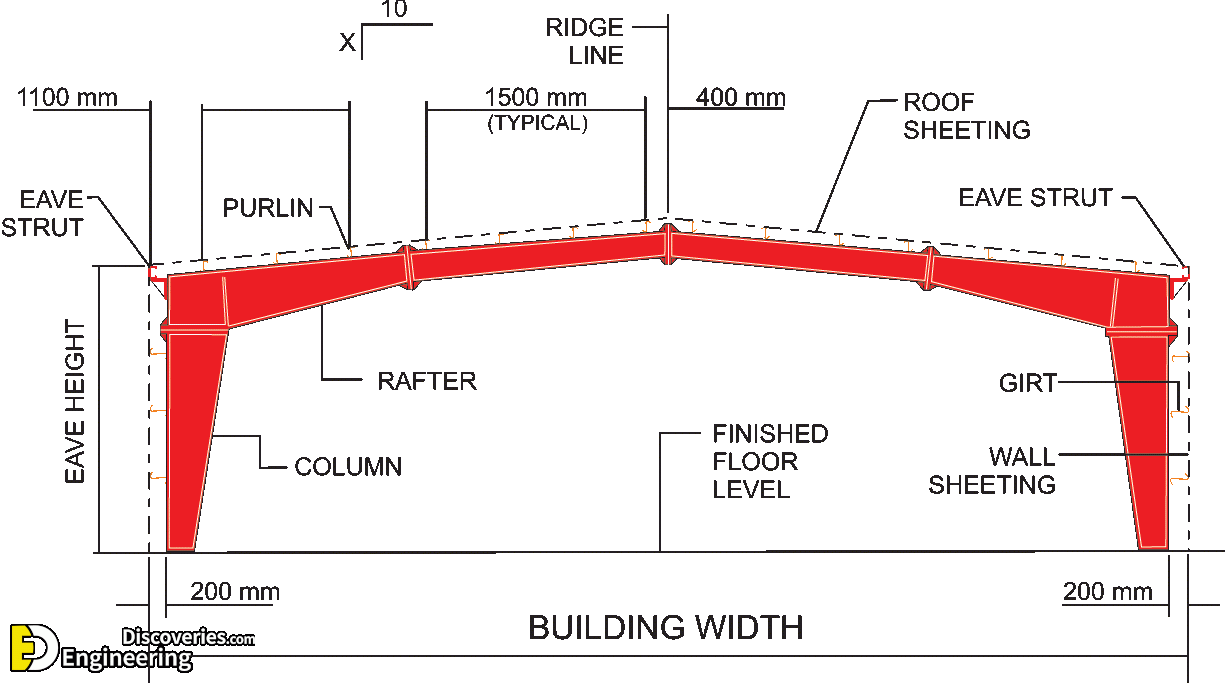
A structural member which is primarily responsible for carrying and distributing the applied load.

The center to center distance- between individual fasteners in a line of the fastener.
Secondary members is that which is provided for stability and or restraining the main members from buckling or similar modes of failure.
Unless otherwise defined in this standard the welding terms used shall have the meaning given in IS: 8121957.
The minimum yield stress of the material in tension.

Click Here To See What is the steel structure? Advantages And Disadvantages
Loading related articles...
Loading recent articles...
Loading featured articles...
