
When a reinforced concrete beam is subjected to vertical loads, it experiences internal forces known as shear forces. These forces result from the changing bending moment along the beam’s length and are most significant near the supports. Shear forces can lead to the formation of diagonal cracks, which, if not properly addressed, can cause a sudden and catastrophic failure of the beam. Understanding how these cracks form and how they are resisted is fundamental to the safe design of reinforced concrete structures.
The Nature of Shear and Diagonal Tension
Concrete is strong in compression but weak in tension. While the primary bending of a beam induces horizontal compressive and tensile stresses, shear forces introduce a more complex stress state. At any point within the beam, shear stress is accompanied by a vertical shear stress of equal magnitude. The combination of these shear stresses with the bending stresses results in principal stresses, which are the maximum and minimum normal stresses at that point.
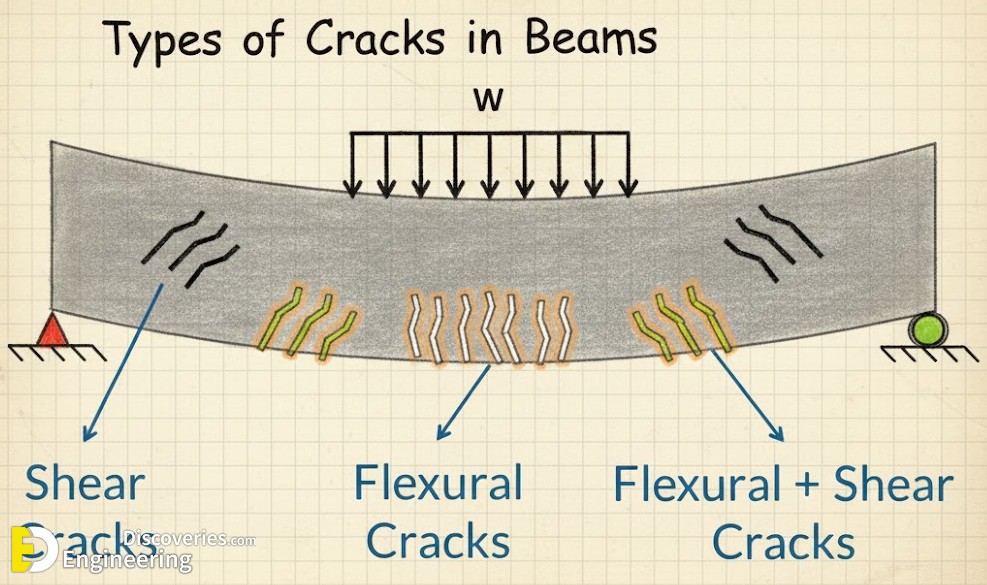
The critical outcome of this stress combination is the development of diagonal tension. In areas of high shear and low bending stress (typically near the supports), the principal tensile stress is oriented at approximately a 45-degree angle to the horizontal axis of the beam. When this diagonal tension exceeds the tensile strength of the concrete, a crack will form perpendicular to the direction of the principal tensile stress. This is the genesis of a shear crack.
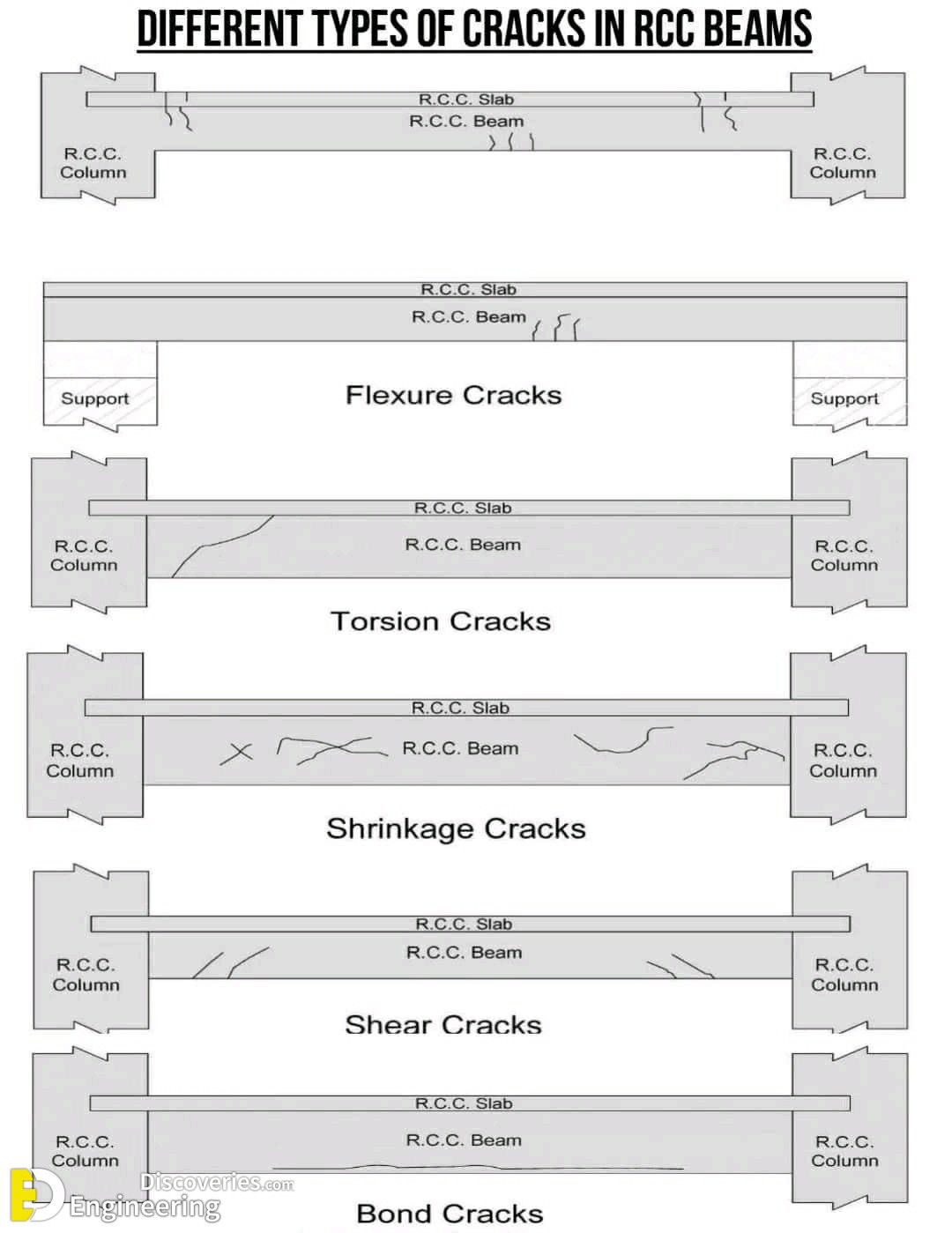
Shear-related cracks in reinforced concrete beams can be broadly categorized into two main types:
Web-Shear Cracks
These cracks typically initiate in the web (the central portion) of the beam, in regions where shear stress is high and bending stress is low. They are characterized by their diagonal orientation, usually starting from the interior of the beam and propagating towards the top and bottom flanges. Web-shear cracks are a direct result of the principal tensile stresses exceeding the concrete’s tensile capacity in an uncracked section of the beam.
Flexure-Shear Cracks
These cracks are more common and begin as vertical flexural (bending) cracks at the bottom of the beam, in the tension zone. As the load increases, these vertical cracks propagate upwards. In regions of high shear, these flexural cracks will then change direction and extend diagonally towards the nearest support. The transition from a vertical to a diagonal crack is what defines a flexure-shear crack.
The Crucial Role of Shear Reinforcement (Stirrups)
To counteract the dangerous effects of diagonal tension and prevent shear failure, steel reinforcement in the form of stirrups is placed vertically within the beam. Stirrups are typically U-shaped or closed rectangular hoops that enclose the main longitudinal reinforcement.
The function of stirrups can be understood through the truss analogy. In this model, the reinforced concrete beam is visualized as a truss, where:
When a diagonal shear crack forms, the stirrups that cross the crack are put into tension. They effectively “stitch” the crack together, preventing it from widening and propagating. This allows the internal forces to be redistributed, enabling the beam to continue carrying the load. The spacing of the stirrups is critical; they must be close enough to ensure that any potential diagonal crack will be intercepted by at least one stirrup.
The presence of stirrups provides several key benefits:
Click Here To See Bending Moment Diagram: A Comprehensive Guide For Engineers
Loading related articles...
Loading recent articles...
Loading featured articles...
