
Key Information Before You Start
Before you can calculate the materials, you need to know three things:
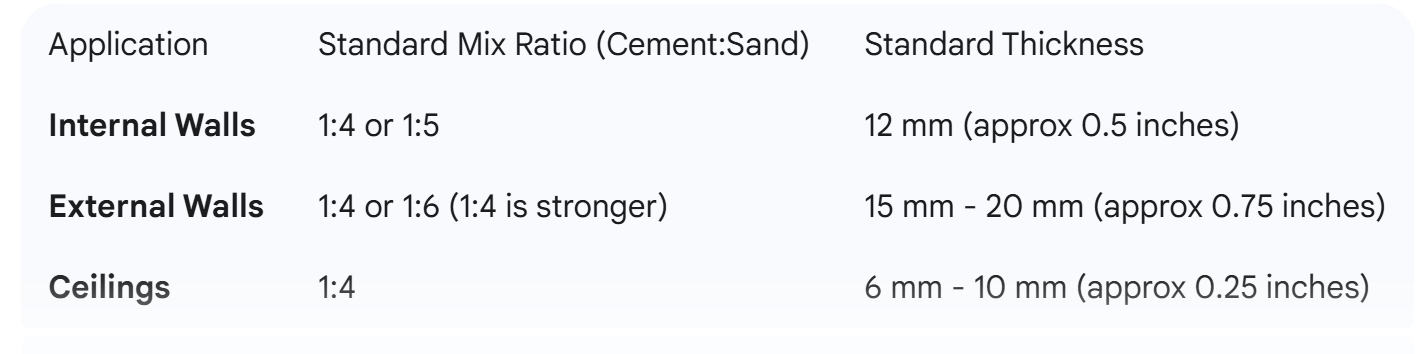
Here are the standard values you’ll need:
How to Calculate Cement and Sand: A Step-by-Step Guide
Follow these 5 steps to find the exact quantities you need.
Measure the length and height of your wall.
Area = Length × HeightArea = 5 m × 3 m = 15 m²This is the volume of the plaster after it’s mixed with water and applied to the wall.
Wet Volume = Area × Plaster Thickness12 mm = 0.012 mWet Volume = 15 m² × 0.012 m = 0.18 m³Step 3: Calculate the Dry Volume of Mortar
This is the most important step. The volume of dry materials (cement + sand) is always more than the final wet volume. This is because the fine cement particles fill the voids (empty spaces) in the sand, and we must also account for waste.
Dry Volume = Wet Volume × 1.33
Dry Volume = 0.18 m³ × 1.33 = 0.2394 m³Step 4: Calculate the Quantity of Cement
Now, we use the mix ratio to find out how much of the dry volume is cement.
1 + 4 = 5Cement Volume = (Dry Volume × Cement Part) / Sum of RatiosCement Volume = (0.2394 m³ × 1) / 5 = 0.04788 m³To find the number of cement bags: The standard volume of one 50kg bag of cement is 0.0347 m³.
- Formula:
Bags of Cement = Cement Volume / 0.0347- Example:
0.04788 m³ / 0.0347 m³ = 1.38 bags- Result: You should buy 2 bags of cement.
Step 5: Calculate the Quantity of Sand
Finally, we calculate the amount of sand needed.
Sand Volume = (Dry Volume × Sand Part) / Sum of RatiosSand Volume = (0.2394 m³ × 4) / 5 = 0.19152 m³Note on Sand Units: Sand is often sold in cubic feet (cft) or tonnes.
- To convert to Cubic Feet (cft):
1 m³ = 35.3147 cft- Example:
0.19152 m³ × 35.3147 = 6.76 cft- Result: You will need 0.19 m³ or 6.76 cft of sand.
Example Summary (For a 15 m² Wall)
Here are the final materials for plastering a 15 m² wall at 12 mm thickness with a 1:4 mix ratio:
Loading related articles...
Loading recent articles...
Loading featured articles...
