
Understanding how a beam behaves under a Uniformly Distributed Load (UDL) is crucial in the fields of structural engineering, civil design, and construction planning. UDL is one of the most common loading scenarios, where the load is spread evenly across the entire span of a beam. This article provides a comprehensive and in-depth analysis of the structural response, internal forces, stress distribution, and reinforcement detailing in a beam subjected to UDL.
What Is a Uniformly Distributed Load (UDL)?
A Uniformly Distributed Load (UDL) is a load that is evenly spread over a length of a structural element. This means every unit length of the beam carries the same load intensity, typically expressed in kN/m or N/mm.
Under UDL, the maximum bending moment occurs at the center of a simply supported beam, while shear forces are maximum at the supports. These load effects significantly influence the design and placement of reinforcement in reinforced concrete beams.
Structural Behavior of Beams Under UDL
Deflection Pattern and Bending Moment
When a beam is subjected to UDL, it bends into a concave shape, typically downward in the middle. The bending moment diagram for a simply supported beam under UDL is a parabolic curve, peaking at mid-span. This deflection creates tensile stresses at the bottom fibers and compressive stresses at the top fibers of the beam.

Tension occurs at the bottom of the beam.
Shear force is at its maximum, and moment is zero.
Stress Zones in Beam Cross-Sections
To resist the internal moments and shears caused by UDL, the beam’s cross-section experiences a differentiated stress profile:
This stress differentiation demands reinforcement placement accordingly. Concrete is strong in compression but weak in tension, hence steel reinforcement is provided in the tensile zones.
Reinforcement Detailing in Beams under UDL
1. Tension Reinforcement
The main reinforcement is provided at the bottom of the beam to counter the tensile forces that occur due to downward bending at mid-span. This is especially important for simply supported beams.
2. Compression Reinforcement
In some cases, such as deep beams or continuous beams, compression reinforcement is also introduced at the top of the section:
3. Shear Reinforcement (Stirrups)
Stirrups or links are crucial in resisting shear forces:
Types of Beams and Reinforcement Strategies
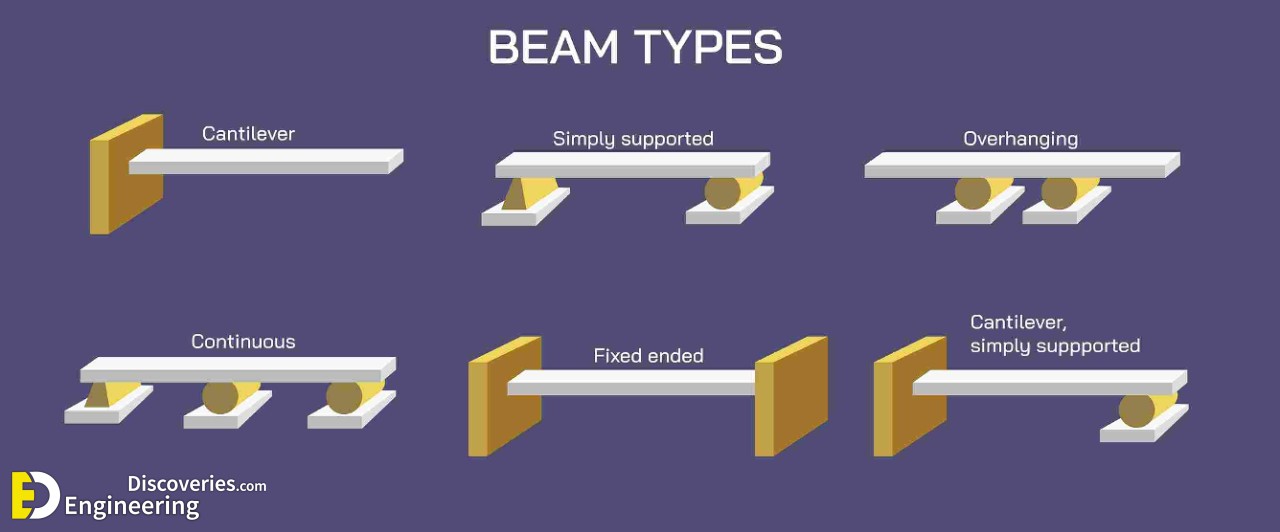
1. Simply Supported Beam
2. Continuous Beam
3. Cantilever Beam
Design Considerations for UDL Beams
1. Span-to-Depth Ratio
A balanced ratio ensures that the beam is neither too deep (uneconomical) nor too shallow (prone to deflection).
2. Minimum Reinforcement
As per IS 456:2000 and other international codes, a minimum percentage of reinforcement must be provided, even if calculations show lesser demand, to handle shrinkage and temperature effects.
3. Concrete Grade and Steel Type
Failure Modes in Beams Under UDL
Beams not properly designed or detailed for UDL can fail due to:

Proper detailing, quality materials, and code-compliant design prevent these failures.
Conclusion: Efficient Reinforcement Design is Key
An efficient beam design under UDL must ensure:
Click Here To See 4 Important Rules When Designing A Concrete Torsion-Exposed Beam
Loading related articles...
Loading recent articles...
Loading featured articles...
