
Finding the angle between two sides of a triangle or plot of land doesn’t always require advanced tools. With a simple measuring tape and basic geometry, you can accurately determine the angle on the ground. This easy and practical method helps engineers, students, and surveyors work efficiently without specialized instruments.
Understanding the Basic Concept
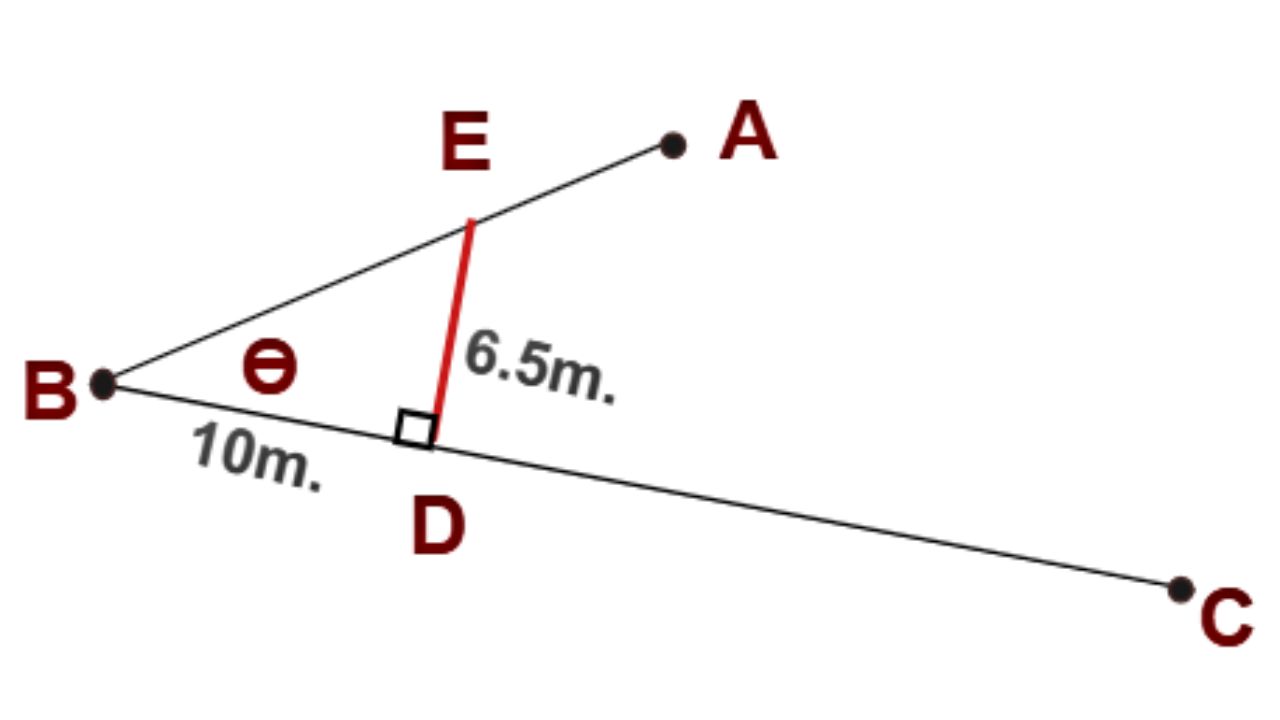
To determine an unknown angle using a measuring tape, we’ll consider three points — A, B, and C — located on a flat land surface. The goal is to find the angle θ (theta) formed at point B between lines AB and BC.
This process involves basic trigonometry, specifically the tangent function. You can easily calculate the angle once you measure the necessary distances.
Step 1: Mark the Points and Draw the Lines
Start by marking the three points A, B, and C on the ground. Draw the lines AB and BC clearly using line-out powder or a line-out string. These lines represent the two sides forming the angle you need to measure.
Ensure both lines are straight and visible. This step lays the foundation for accurate results.
Step 2: Measure a Specific Length on Line BC
Use your measuring tape and measure 10 meters along the line BC, starting from point B. Mark the end of this measurement as point D. This segment, BD, will act as your adjacent side in the trigonometric calculation.
Accuracy in this measurement is crucial for a reliable angle value.
Step 3: Draw a Perpendicular Line from Point D
Next, you need to draw a perpendicular line from point D to the line BC. This line should intersect BA at some point, which we’ll label as point E. The line DE becomes your opposite side in the right triangle you’re forming.
If you don’t have a set square or level, use the 3-4-5 method to create a perfect right angle. This simple ratio (3:4:5) ensures your line DE is perpendicular to BC.
Step 4: Measure the Opposite Side (DE)
Now, measure the distance of DE using your measuring tape. Suppose the measured value is 6.5 meters. This measurement gives you the height of your triangle relative to base BD.
Record this value carefully, as it will be essential for calculating the angle.
Step 5: Apply the Tangent Formula
Once you have both the opposite side (DE) and the adjacent side (BD), you can calculate the angle using the tangent formula:
tan θ = opposite side / adjacent side
Substitute the measured values:
tan θ = 6.5 / 10
Now, take the inverse tangent (tan⁻¹) of this ratio to find the angle:
θ = tan⁻¹ (0.65)
θ = 33.02 degrees
Hence, the angle θ is approximately 33.02 degrees.
Step 6: Verify and Record Your Result
After calculating the angle, recheck your distances to ensure precision. Even a small measurement error can slightly change the result. Once confirmed, record the angle for your project or survey notes.
This simple technique eliminates the need for a theodolite or any advanced tool, yet it provides dependable accuracy.
Click Here To See Accurate Building Estimation Using The Center Line Method
Loading related articles...
Loading recent articles...
Loading featured articles...
